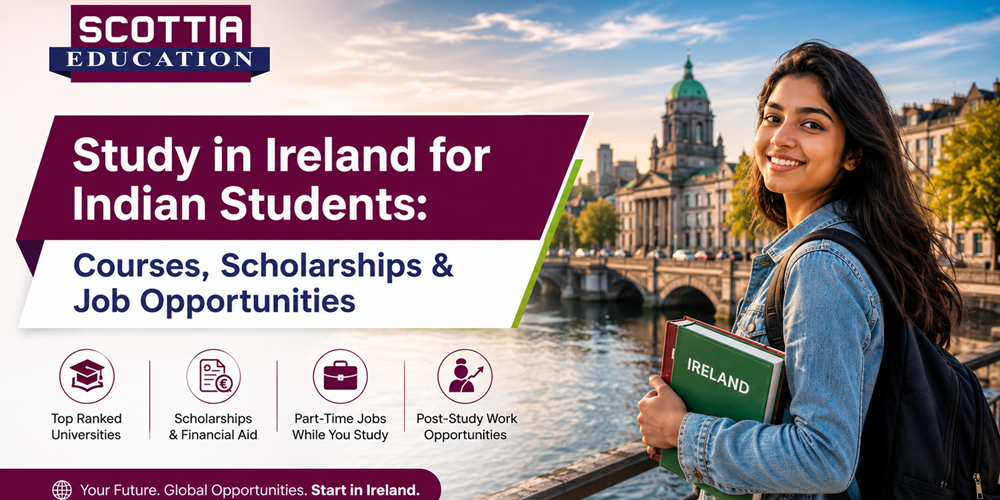
Ireland has emerged as a hidden gem among top European study destinations for Indian students. This provides internationally recognised qualifications, English-medium delivery, firm connections to local/global employers and crucially the chance for post graduate stay back.
Study in Ireland for Indian students is a serious contender for students choosing between the UK, Canada, Australia & Europe. In Ireland, reputable universities sit within a more manageable education system and cities such as Dublin, Cork, Galway and Limerick offer proximity to tech, finance, pharma and professional services.
But picking Ireland isn’t as simple as choosing a university. You need to get familiar with the appropriate course, scholarships available, visa process and scope of learning so when you make a decision you do it wisely.
Why Study in Ireland from India?
One major advantage is language. Most international programmes in universities have their courses taught through English, therefore it ensures that Indian students adapt to the classroom learning without having any previous knowledge of a foreign European-language.
The country also provides higher-education programmes for Levels 6 to 10 of Ireland’s National Framework of Qualifications. For international students intending to remain over 90 days, it is typically a requirement that they choose an approved programme under the Irish immigration framework.
Ireland also gives an international education environment. This way, you can connect with classmates from Europe, Asia, Africa, the Middle East and much more.
That combination is of help for Indian students seeking an international professional exposure along with a qualification. Get details on Study Abroad Education Consultants in Kollam
Popular Courses in Ireland for Indian Students
Choosing a programme should depend on your previous education and career plans rather than simply following a trending course.
Some of the best courses in Ireland for Indian students include:
- Computer Science and Information Technology
- Data Science and Artificial Intelligence
- Cybersecurity
- Business Analytics
- Finance and Accounting
- MBA and Management
- Engineering
- Pharmaceutical Sciences
- Biotechnology
- Healthcare and Life Sciences
- Digital Marketing
- Supply Chain and Logistics
Technology-related courses remain particularly attractive because they can develop skills relevant to software, cloud computing, analytics, AI and cybersecurity roles. Meanwhile, students from commerce backgrounds often consider finance, accounting, business analytics and management programmes.
Similarly, Ireland’s established pharmaceutical and life-sciences environment makes related programmes worth considering for eligible science graduates. Looking for a Study Bsc in UK
Bachelor’s and Master’s Degrees in Ireland
Both undergraduate and postgraduate programmes are open to Indian students.
Typically, a suitable Class 12 qualification is required to study a bachelor’s degree along with proof of English proficiency and specific entry requirement by each university. However, the requirements are drastically different across universities and programmes.
Typically, for postgraduate study a recognised undergraduate degree. Competitions courses might also scrutinize academic record, relevant professional experience or projects done in your own time.
In addition, students may be asked to take IELTS, TOEFL, PTE or another academic English qualification that they will have to give me whatever something more University exams accepted by the specific institution they are applying for.
So, never be sure that eligibility taking place at one university will be applicable all others as well.
Scholarships in Ireland for Indian Students
The cost of overseas education can be a concern for many families. Fortunately, students can explore government and institution-based Ireland scholarships for Indian students.
One significant option is the Government of Ireland International Education Scholarship (GOI-IES). For the 2026 programme, the Higher Education Authority states that the scholarship provides a €10,000 stipend and a full fee waiver for one year of study for successful applicants.
Colleges and universities also have their own merit scholarships, tuition discounts and student awards for international students, However, values, eligibility and deadlines are different for these.
This means that students need to research funding at the same time that they research universities, instead of waiting for an admission offer to come in.
Academics are helpful, but scholarship committees might look at accomplishments, character, leadership, professional goals and the merit of the overall application. Get details on Study Masters Degree in UK
Can Indian Students Work While Studying in Ireland?
The answer for yes, eligible international students will be able to undertake work whilst studying if they have student immigration permission that allows them to do so.
Those in possession of a Stamp 2 permission to work may generally work for no more than 20 hours per week during the term time and 40 hours per week during specified holiday dates. This is backed up by Irish employment-permit guidance.
Working part-time may benefit students by providing experience while also helping them pay for day-to-day expenses. But it should not become the primary financial plan for going abroad to study.
You need to Plan for your Tuition, Accommodation and core needs before travelling.
Job Opportunities in Ireland After Graduation
For many Indian students, career prospects are a major reason for considering Ireland.
Graduates may find opportunities across areas such as:
IT and software | Data analytics | Cybersecurity | Engineering | Financial services | Accounting | Pharmaceuticals | Life sciences | Supply chain | Business services
Of course, a degree never guarantees employment. Your skills, course choice, internships, networking, communication ability and the labour market at the time of graduation all matter.
Therefore, students should start career preparation during the course itself rather than after completing it.
Build your LinkedIn profile, attend university career events, improve your CV and look for relevant internships or practical projects. Looking for a UK Admission Consultants in Kochi
Post-Study Work Opportunities in Ireland
The Third Level Graduate Programme in Ireland is especially significant for foreign students from outside the EEA.
Here, eligible graduates having approved Irish qualifications may be given Stamp 1G permitting them to remain and look for jobs in Ireland at Graduate Level. The Government of Ireland residence permit can often give Level 8 graduates especially eligible to receive between 12 months; and master’s graduates the possibility of receiving a further 12-months depending on programme circumstances.
For graduates during Stamp 1G, they are permitted to work full-time without the requirement of an employment permit for the purpose of seeking appropriate employment and to transition as necessary to a General Employment Permit, Critical Skills Employment Permit or another relevant permission.
Which makes course selection especially important. A degree that enhances skills employers are eager-looking for, will help your career after university.
Related Services:
How to Apply to Study in Ireland from India
A typical application journey looks like this:
- Decide your preferred subject and career direction.
- Shortlist suitable Irish universities and colleges.
- Check academic and English-language eligibility.
- Prepare transcripts, certificates, CV and supporting documents.
- Submit university applications before the relevant deadlines.
- Explore scholarships and available financial support.
- Accept the preferred offer and complete required payments.
- Arrange finances, accommodation and insurance.
- Complete the applicable student visa and immigration process.
- Prepare for travel and arrival in Ireland.
Most importantly, check the latest requirements for your exact course and circumstances rather than relying on old online posts.
Related Articles:
» Exploring Study Opportunities in New Zealand
» Study in Ireland: Admission Requirements for International Students
» Why Ireland Is a Leading Destination for Studying Abroad?
» Ireland as a Study Abroad Destination: What You Need to Know?
» Why New Zealand is Becoming a Top Study Destination?
Start Your Ireland Study Journey with Scottia Education
Course and university options along with scholarship and documentation planning alongside career plans make studying in Ireland from India seem overwhelming.
Scottia Education could provide students with a much more structured way to go about this process. Support is based on two features—students’ academic backgrounds and their plans for the future, whether that be related to university admissions and course selection in Ireland or further abroad.
Getting admission somewhere is not what the right decision means. Rather, it is about pursuing an academic progression that makes more academic, economic and professional sense.
When Ireland is already on your a-list, do the research early. Having a well-planned application provides you ample time to compare universities, search for scholarships and adequately prepare yourself for the next step in your education.
FAQs: Study in Ireland for Indian Students
Yes. Ireland has English medium programmes along with worldwide accepted qualifications and job prospects available in technology, finance, engineering, pharmaceuticals among other fields.
Some of the in-demand fields include Computer Science, Data Analytics, Artificial Intelligence ( AI ), Cyber Security, Finance, Business Analytics etc. Which option is best depends on what you are doing.
Yes. Students are free to search for government scholarships as well as individual university awards. Different programmes have different eligibility criteria and levels of funding available.
The 2026 GOI-IES scheme provides successful recipients with a €10,000 stipend and a full fee waiver for one study year.
Eligible students on qualifying Stamp 2 permission are normally entitled to work up to 20 hours per week during term time and 40 hours per week during certain holiday periods.
Current conditions allow eligible master’s graduates to use the Third Level Graduate Programme and they can also be granted Stamp 1G permission for a duration of up to two years.
Universities require evidence of English ability, but accepted tests and exemptions vary. Check your institution’s current admission requirements.
Many programmes admit students around the autumn academic intake, while some institutions also provide additional intakes. Availability depends on the course and university.
Technology is one career area graduates may explore, including software, data, cloud and cybersecurity roles. Employment, however, depends on skills and market conditions.
Eligible graduates on Stamp 1G can work full-time while seeking suitable graduate employment under the Third Level Graduate Programme.
Starting several months before the intended intake is sensible because admission, scholarships, finances, accommodation and immigration formalities all require preparation.
Scottia Education can support students with course and university selection, application planning and guidance through the broader Ireland study abroad process for Indian students.
 Over 10 years of experience we’ll ensure you always get the best guidance.