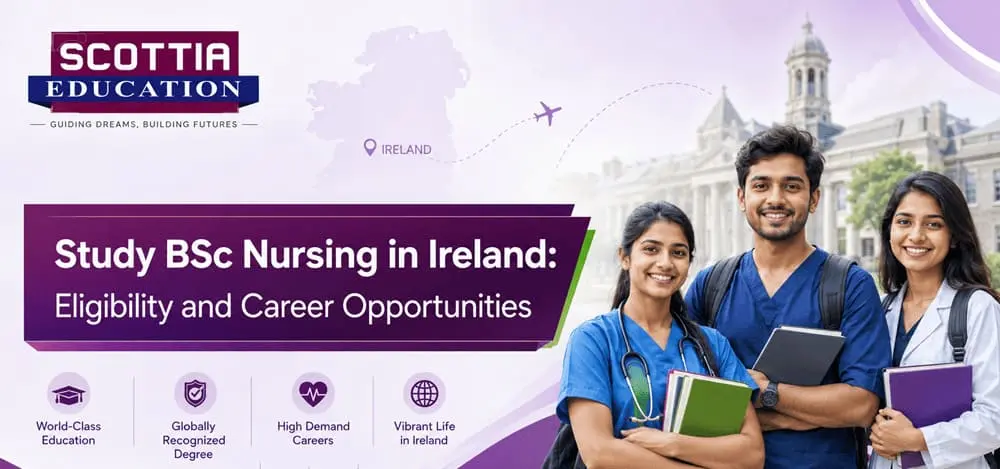
Ireland has emerged to be a hot spot for students aspiring for an accredited healthcare degree, a hands-on clinical experience and global career options. A BSc Nursing in Ireland integrates university-based modules with hands-on experience within the hospitals, community ability and specialist healthcare settings.
Beyond Completing the Degree for International Students Ireland — With an English-speaking education system, established healthcare institutions and regulated nursing programmes. However, admission remains competitive. Students must have appropriate academic subjects, English-language competency and authentic motivation for a patient-care career.
Why Study Nursing in Ireland?
Nursing degree in Ireland, which are validated against standards outlined by the Nursing and Midwifery Board of Ireland (NMBI). NMBI approval is only available to recognised colleges and universities, therefore all programmes leading to professional registration must be NMBI approved. Therefore, students need to verify that the desired course is available in the valid list of authorized-programmes before registering.
A standard general nursing degree in Ireland aimed at developing clinical judgement, communication and evidence-based skills of care. Placements on the other hand gives them a taste of the realities of working with patients, families, doctors and health care teams. Get details on Study in Ireland.
Other reasons students consider Ireland include:
- Internationally recognised universities
- Strong emphasis on clinical education
- Modern hospitals and healthcare facilities
- Opportunities to work with diverse patient groups
- Postgraduate options in specialist nursing areas
- A potential post-study work route for eligible non-EEA graduates
Types of Undergraduate Nursing Programmes
Students should not assume that every nursing degree has the same focus. Ireland offers several undergraduate pathways, each preparing graduates for a particular area of professional practice.
|
Nursing pathway |
Main area of study |
Typical career direction |
|
General Nursing |
Adult health, medical and surgical care |
Hospitals, clinics and community care |
|
Children’s Nursing |
Healthcare for infants, children and adolescents |
Paediatric wards and children’s hospitals |
|
Mental Health Nursing |
Psychological wellbeing and psychiatric care |
Mental health services and community teams |
|
Intellectual Disability Nursing |
Support for people with intellectual disabilities |
Residential, community and specialist services |
|
Children’s and General Nursing |
Combined adult and paediatric preparation |
Adult and children’s healthcare settings |
Most undergraduate nursing programmes run for approximately four years. However, the combined Children’s and General Nursing degree normally takes four and a half years because it leads towards qualifications in two nursing divisions.
Eligibility for BSc Nursing in Ireland
The BSc Nursing Ireland eligibility varies from one university to another. Therefore, students need to verify the official course page before applying.
Academic Qualifications
Senior secondary education equivalent to the Irish Leaving Certificate is usually required of applicants. Universities may require you to have a pass in:
- English
- Mathematics
- Biology
- Chemistry
- Physics or another laboratory science
Other institutions might accept applicants who have studied another recognised science, rather than Biology. That said, nursing is an academically intense program so great science preparation helps ease the first year.
International qualifications are assessed individually. Indian students have to provide Class 10 and Class 12 certificates, detailed mark sheets as well as documents that show they meet the university’s subject requirements.
English-Language Proficiency
International students usually require an accepted English-language examination as they will be taking lectures, examinations and clinical communication in English. Most universities accept IELTS Academic, TOEFL iBT, PTE Academic or another official qualification.
Required scores can vary. In addition, nursing courses may demand stronger individual component scores than general business or arts programmes. This happens because students must communicate safely and clearly during clinical placements.
Therefore, applicants should avoid relying on a general university English requirement. Instead, they should check the specific nursing programme requirement.
Health and Fitness Requirements
Nursing involves direct contact with patients. As a result, successful applicants may need to complete:
- Medical fitness declarations
- Vaccination or immunisation checks
- Garda or police clearance
- Occupational health screening
- Manual-handling or infection-control training
Students are to honestly disclose any relevant health conditions. Studying nursing may not be impossible because of a health condition, although the university may need to establish whether sensible adjustments are needed.
Personal Suitability
Good academic marks certainly matter. But nursing also has patience, maturity and communication.
Ideal candidates should be team-oriented, responsible and able to manage high-stress clinical settings. They may also consider a personal statement, references or an interview to determine the prospective student’s motivation and familiarity with the profession. Looking for a Overseas Admission Consultant in Kerala?
Application Process for International Students
Depending on their nationality, qualifications & university opted by students, the application route could be a different path.
You are shown Irish higher education institutions that use the Central Applications Office (CAO) which processes applications for many undergraduate programmes. But some international applicants must apply directly to the university.
A practical application process includes:
- Shortlist NMBI-approved nursing programmes.
- Review academic and English requirements.
- Prepare transcripts, certificates and passport copies.
- Complete the university or CAO application.
- Submit a personal statement and references where requested.
- Attend an interview or assessment when applicable.
- Accept the offer and pay the required deposit.
- Arrange a student visa, insurance and accommodation.
Nursing places can fill quickly. Therefore, students should begin researching courses well before the expected intake.
What Will You Study?
A Bachelor of Science in Nursing in Ireland blends theory, simulation and clinical practice. Modules may include:
- Anatomy and physiology
- Pharmacology
- Nursing ethics
- Health assessment
- Medical and surgical nursing
- Public health
- Psychology
- Evidence-based practice
- Patient safety
- Clinical decision-making
Components of the programme consist mainly of clinical placements. During these placements, students are supervised and develop practical competency. They might work in medical wards, surgical units, neighborhood services, lodging and specialized offices. Get details on Study Abroad Educational Consultant in Kerala.
Registration After Graduation
Completing a degree alone does not automatically give someone unrestricted permission to work as a nurse. Graduates must meet the relevant registration requirements.
Students who complete an approved Irish programme can follow the NMBI registration process for graduates. Anyone practising as a nurse or midwife in Ireland must remain registered with NMBI.
International students should also separate professional registration from immigration permission. NMBI registration confirms professional eligibility, whereas an immigration stamp or employment permit confirms the person’s legal right to remain and work in Ireland.
Career Opportunities After BSc Nursing
A nursing graduate may find opportunities across public, private and community healthcare settings.
Potential workplaces include:
- General hospitals
- Private hospitals
- Nursing homes
- Rehabilitation centres
- Community health services
- Mental health facilities
- Disability support organisations
- Home-care providers
- Specialist clinics
- Healthcare charities
Graduates can begin in staff-nurse positions and later move into specialist, managerial, educational or research roles.
Possible career paths include:
- Registered General Nurse
- Paediatric Nurse
- Mental Health Nurse
- Intellectual Disability Nurse
- Community Nurse
- Theatre Nurse
- Emergency Department Nurse
- Clinical Nurse Specialist
- Nurse Manager
- Nurse Educator
- Research Nurse
- Advanced Nurse Practitioner
It is also possible to deepen knowledge in intensive care and oncology, emergency nursing, public health, infection prevention, gerontology or even healthcare leadership. NMBI has officially recognised post-registration programmes available for nurses wishing to gain an additional qualification. Looking for a Educational Consultancy in Kerala?
Post-Study Work Opportunity
The Third Level Graduate Programme may also apply to eligible non-EEA graduates of an Irish Level 8 qualification. Based on the current immigration guidelines, a Level 8 graduate can be issued with up to 12 months on Stamp 1G depending on the programme and student-permit limits respectively.
Stamp 1G allows holders to take up work that is aligned with graduation in their skilled and knowledge based occupations. However, it should not be forgotten that immigration policies change from time to time and students need to confirm the latest laws before taking any financial or career action.
Related Services:
» Study Abroad Education Consultants in Thiruvananthapuram
» Study Abroad Education Consultants in Kollam
» UK Admission Consultants in Kochi
How Scottia Education Can Support Your Application
There is more to applying for a nursing course than merely choosing a university. Students are required to compare entry requirements, how to apply, course accreditation and career outcomes.
Scottia Education provides support for course shortlisting, documents for applying to any university or college, planning for English-test preparation as well as personal-statement writing to blanket all the intricacies of visa traveling. Structured support helps ensure undesirable mistakes are avoided, and a programme that fits the relevant academic record and long-term goal is chosen.
Related Articles:
» Why Choose Ireland for Higher Education? Top UG and PG Courses
» Study in Ireland: Admission Requirements for International Students
» Why Ireland Is a Leading Destination for Studying Abroad?
» Ireland as a Study Abroad Destination: What You Need to Know?
» Ireland’s Post-Study Work Visa: What Indian Students Should Know?
Achieve Your Nursing Career Goals in Ireland
BSc Nursing studying in Ireland can be the pathway to a rewarding global career in healthcare. But students must plan meticulously. Here, academic eligibility, English proficiency and health checks & other registration are very important.
Do your research and comparison, study each entry condition painstakingly, above all, apply early. More importantly, select nursing because it is something you want to do for people! The work can be hard, but it provides passion with professional development and multiple career paths for the right student.
FAQs: Study BSc Nursing in Ireland: Eligibility and Career Opportunities
Most undergraduate nursing degrees take approximately four years. A combined Children’s and General Nursing programme usually takes four and a half years.
Yes. An international student applies and takes admission when they fulfill the academic, english-language, health and documentation requirements of the university.
Other universities suggest or require Biology, or another laboratory science. However, because UK degree programmes set different subject criteria that applicants must check for each programme individually.
English language requirement: IELTS Academic, TOEFL iBT, PTE Academic or another accepted test details. Similarly, other degrees may have less stringent component requirements than nursing programmes.
Yes. It enables Indian students to get admissions if their marks and subjects in Class 12 are good enough to meet the standards for colleges internationally.
An Irish nursing degree is well recognised. However, if a graduate relocates to another country, they must also satisfy the registration and licensing conditions of that country.
Yes. Eligible nursing courses must comprise supervised clinical practice within an appropriate hospital or community service, or specialist healthcare setting.
Eligible graduates may apply for professional registration and suitable immigration permission. A job offer alone does not replace NMBI registration or employment requirements.
NMBI registration confirms that a nurse meets Ireland’s professional standards. A person must hold the appropriate registration to practise nursing in Ireland.
Careers pathways available across general, mental health, children and wards for those in Intellectual Disability Nursing! Depending on a student’s interest and patient population desired will decide the better choice.
Yes. Graduates may undertake postgraduate studies in specialist nursing, public health, healthcare management; or education research or advanced practice.
Students should start their research at least a couple months before the application phase. You are really advanced in your preparation so this gives you enough time for English tests, documents, visa processing and accommodation.
 Over 10 years of experience we’ll ensure you always get the best guidance.