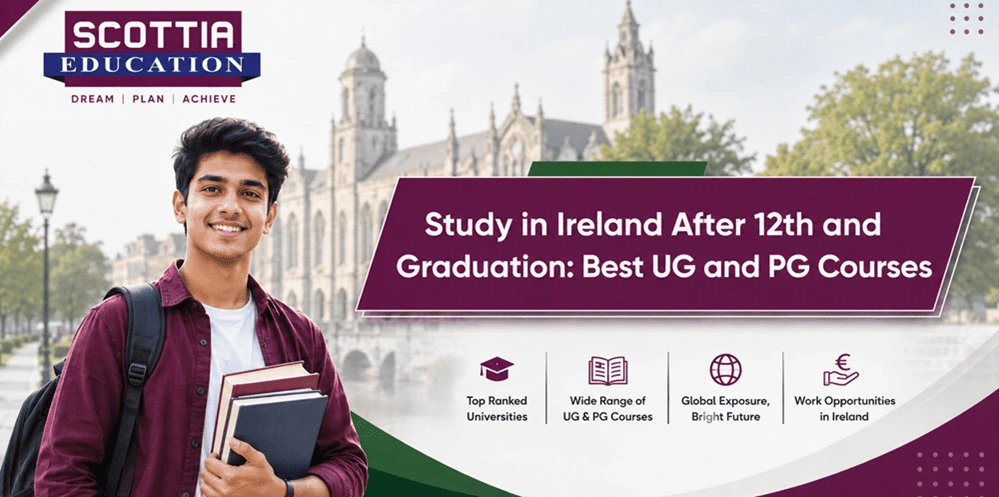
Ireland has quietly developed itself into one of the most pragmatic countries for Indian and overseas students. They provide English-taught degrees, world-class universities, great job connections and the best student atmosphere. Furthermore, Ireland is the only English speaking nation in the European Union and this benefits students wishing to pursue a European education without having to conform with learning a brand new language.
Choice of course plays a significant role when it comes to students planning to move ahead and study in Ireland after 12th or after graduation. A good programme drives career GET from better WORK exposure and improved SHARE of work post-study. The possible benefit of this post-graduation work route for Irish non-EEA graduates is known as the Third Level Graduate Programme — and it permits international students with a recognised Irish Qualification at Level 8 or Level 9 (Level Finder) to stay in Ireland after they graduate, however strict immigration rules exist along with time restrictions.
Why Study in Ireland?
Although Ireland offers quality education, this is why students choose it as a best option. The country boasts robust technology, pharmaceutical, finance, healthcare, business, engineering, hospitality and data science industries. Hence, students can search for courses that are closely aligned with the prevailing job markets.
Moreover, a lot of Irish universities have collaboration with employers through internships, projects, research and career services. Consequently, students do not factor only theory in their studies. They also learn to use their knowledge in real workspaces.
The second major merit is working part time. International students outside the EU / EEA / Switzerland and less than 20 hours work per week from Stamp 2 permission exist during term time, according to official student work rules. Get details on Study in Ireland.
Study in Ireland After 12th: Best UG Courses
After completing 12th, students can apply for undergraduate degrees, usually bachelor’s programmes. Most UG degrees in Ireland take three to four years, depending on the course and institution. However, students must choose based on their academic background, English score, career interest, and long-term goal.
1. Business and Management
Business management in Ireland is one of the most sought after courses for students coming from a commerce background or even any other background, be it humanities or science. Courses may include international business, marketing, finance, entrepreneurship, accounting and human resource management.
This path is often pursued by students that tread lightly with a preference for flexible careers. In addition, Ireland has many multinational firms; therefore business graduates can explore opportunities in administration, sales, finance support, marketing and operations.
2. Computer Science and IT
Ireland has a robust tech sector. As a result, IT courses in Ireland are very popular. Students after 12th science, particularly maths, can pursue degrees in software engineering, cyber security, artificial intelligence, data analytics, cloud computing and information systems.
This is a field for students who like coding, problem-solving, logic, and digital tools. In addition, IT skills continue to be applicable in nearly all industries.
3. Engineering
The other great UG option is engineering, Mechanical engineering, civil engineering, electrical engineering, electronic engineering, biomedical or software engineering.
But engineering programmes can have tighter entry requirements. To get into a professional course, students generally need good grades in maths and science subjects. However, studying engineering in Ireland after 12th opens up global career paths for the right student.
4. Healthcare and Nursing
Health care courses attract students to stable, respectful careers. In this discipline, nursing public health, biomedical science, pharmacy-related studies or healthcare management are the common choices.
But before applying, students should check registration rules, clinical requirements and licensing conditions. Interviews or science subjects are also required for some programmes.
5. Hospitality and Tourism Management
Irish tourism and hospitality market Hence hotel management, tourism, event management and culinary programmes are some student-friendly options for those with interests in people-facing businesses.
These programs also generally involve practical training. Consequently, they can study while building confidence, communication skills and service beliefs.
6. Arts, Media and Design
For more creative students, they have courses in digital media, animation, film studies, graphic design, journalistic communication and fashion and visual arts. Ireland has a bubbling creative culture, with a plethora of programmes dedicated to portfolio development.
But the design and media courses can ask for some samples of your work. So, students should prepare early. Looking for a Educational Consultancy in Kerala?
Study in Ireland After Graduation: Best PG Courses
Students who already hold a bachelor’s degree can apply for postgraduate diplomas or master’s programmes. In most cases, master’s degrees in Ireland take one year, although some programmes may take longer.
1. MSc Data Analytics
If you are from computer science, mathematics, statistics, engineering business analytics or any related background Data analytics in Ireland is a good option to choose. Data visualisation, machine learning, databases, programming, business intelligence and statistical modelling are usually the areas of study involved.
This will help to build a background in many fields as more and more companies depend on data, using this course for analytics, reporting, consulting, fintech, healthcare and technology.
2. MSc Computer Science
If you are looking for advanced technical roles, some of the specializations offered under various streams include MSc Computer Science, MSc Software Engineering, MSc Artificial Intelligence (AI), MSc Cyber Security or MSc Cloud Computing.
These are for technically inclined students. Yet, certain conversion paths take a few students from non-CS sectors if they’ve satisfied minimum coding or maths necessities.
3. MBA and Management Programmes
The MBA in Ireland is a good option for experienced students pursuing leadership, management or business development roles. You may choose MSc Management, MSc International Business, MSc Marketing or MSc Finance instead as a recent graduate.
In addition, many of Ireland´s business schools incorporate case studies, group work and industry linked tasks. This is how students can build real-world business-based thinking.
4. MSc Finance and Accounting
Postgraduate courses related to finance are up for grabs to students having commerce, accounting, economics or business background. MSc Finance, MSc Accounting, MSc Financial Technology, MSc Risk Management and one of the more popular ones is absolutely—so there are a few to pick from.
The nature of the Irish economy also lends itself as an attractive entry point for students pursuing a finance career, particularly with banking, insurance, fintech and corporate finance being significant components of Ireland’s economic base.
5. MSc Pharmaceutical Science and Biotechnology
Ireland is also a big pharmaceutical and life sciences country. Thus, if you have completed life science studies such as biology, chemistry pharmacy, biotechnology microbiology or associated subjects then pharmaceutical science, biotechnology bioprocessing biomedical science and regulatory affairs are good options for you.
And research in, quality control, production, clients research supporting and regulatory roles.
6. Public Health and Healthcare Management
Students from medical, nursing, pharmacy, life science, or healthcare backgrounds can consider public health, health promotion, global health, and healthcare management.
These programmes suit students who want to work in hospitals, NGOs, public health bodies, healthcare administration, or health research. Get details on Overseas Admission Consultant in Kerala.
UG vs PG Study in Ireland: Quick Comparison
|
Study Level |
Best For |
Duration |
Popular Course Areas |
|
Undergraduate after 12th |
Students starting higher education |
3–4 years |
Business, IT, Engineering, Nursing, Design, Hospitality |
|
Postgraduate after graduation |
Students seeking specialisation |
Usually 1 year |
Data Analytics, MBA, Finance, Cyber Security, Public Health |
|
PG Diploma |
Students wanting shorter skill-based study |
1 year approx. |
Business, Computing, Hospitality, Healthcare |
|
Research Programmes |
Students interested in academic/research careers |
Varies |
Science, Engineering, Humanities, Technology |
Admission Requirements for Ireland
Application requirements differ from university to university and course to course. But, students generally require academic transcripts, English language scores, passport, Statement of purpose, LoRs and CV (for PG courses) as well as Portfolio /Interview sometimes.
Universities check from 12th marks (and if subjects are relevant) for UG admission. For PG admission, the bachelor degree and the percentage or CGPA, course match, work experience (if required) and English language proficiency are considered.
In addition, early application is recommended for students as popular courses get filled up quickly. It also allows sufficient time for visa documentation, Education loan processing, accommodation booking and scholarship applications.
Best Course Selection Tips
Generalizing choosing a course is risky. Rather, students must match the course with their profile and job objective. Your choice of the subject also depends on your stream, for example – commerce students will prefer business analytics and if a science student loves lab-based subjects then biotechnology would be their option.
Also should read course modules carefully. Individual universities could offer a course of the same title, but they are taught as different subjects. Hence you must compare different modules, internship opportunities, fees, location of the college, entry requirements and post study work opportunity through the career support.
Related Services:
» UK Study Abroad Consultants in Kerala
» UK Admission Educational Consultants in Kochi
» UK Admission Consultants in Ernakulam
Why Choose Scottia Education?
Scottia Education makes sure you get proper advice rather than getting into any random course. Starting from course selection till the time they get admitted to a university shortlisting, application guidance, SOP support, visa documentation and even pre-departure help is given to students step-by-step.
In addition, Ireland admissions require thorough planning. An incorrect option in a course or document can cause a delay. So, expert advice can cut down on miscommunication and the problems that arise from it as well as increase the likelihood of a hassle-free application process.
Related Articles:
» Why Ireland Is a Leading Destination for Studying Abroad?
» Ireland as a Study Abroad Destination: What You Need to Know?
» Study in Ireland: Benefits, Requirements, and Opportunities
» Job Opportunities After Studying in Ireland
» Student Life in Ireland: What You Need to Know Before Studying Abroad?
Prepare for a Successful Academic Journey in Ireland
Students Who Think Only About University Names Study In Ireland After 12Th & Graduation Equally Important was the right course, right city and budget friendly career plan. Ireland is a perfect fit for UG and PG programs in business, IT, engineering, healthcare, data analytics, finance and banking. biotechnology and hospitality.
Hence, it has also become one of the smartest destinations for doing a degree in Ireland whether you are graduating or opting for a master’s after school. Considering all these parameters, students should select a course with guidance from Scottia Education in accordance to their profile, finances and future objectives.
FAQs: Study in Ireland After 12th and Graduation
Yes, they can apply to universities for undergraduate courses in Ireland after 12th. But they should be assessed with academic and English language criteria.
Courses are available in subjects like business, computer science, engineering, nursing, hospitality, media and design or biotechnology.
Yes, abroad MS/PG diploma/MBA programmes– PG courses or PG research are some of the postgraduate study options available in Ireland for graduates.
PG courses such as data analytics, computer science, cyber security, finance, MBA, biotechnology to public health and pharmaceutical science are viable and sound options with higher return on investment.
Yes, Ireland is one of the best options for Indian Students since it has courses taught in English as well as world-class universities with industry links about post-study work opportunities.
Bachelor’s degrees generally take between three and four years to complete, depending on the course of study and university.
Typically, the majority of master programmes are one year in length, but some have longer course structures.
As per the Irish rules, eligible international students who are granted Stamp 2 permission can engage in part-time work during their studies.
Most universities require proof of English proficiency. IELTS, TOEFL, PTE, or other accepted tests may be used, depending on the institution.
Ireland is good for both. UG is ideal for students starting their higher education, while PG is better for students who want specialisation and faster career movement.
Students usually need academic records, passport, English test score, SOP, recommendation letters, CV for PG courses, financial documents, and visa papers.
Scottia Education can help with course selection, university applications, documentation, SOP guidance, visa support, and pre-departure preparation.
 Over 10 years of experience we’ll ensure you always get the best guidance.